

TL;DR
Date: December 10, 2025.
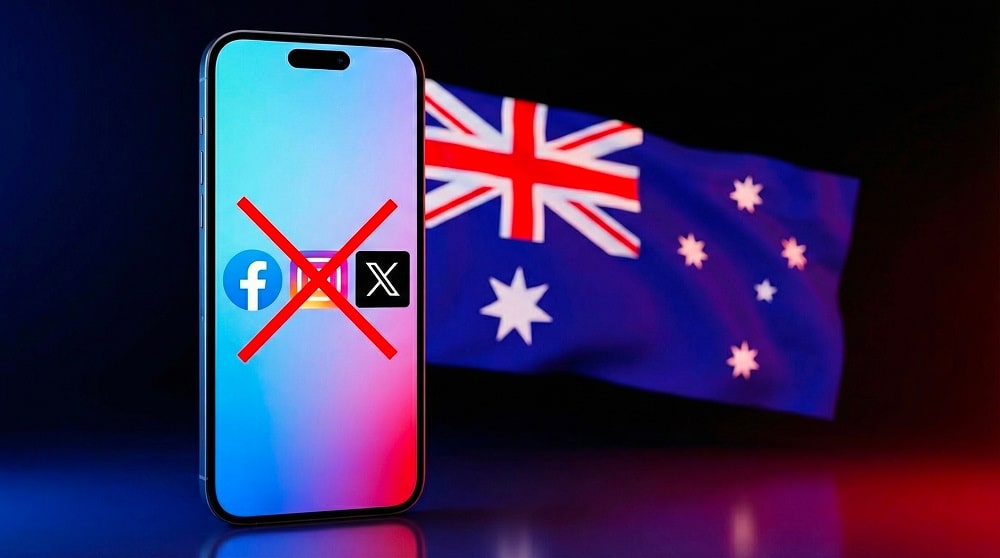
The event: Australia blocked children under 16 from holding accounts on major social media platforms (TikTok, Instagram, X, etc.).
Who is banned: Strictly under-16s. Existing accounts are being purged.
Who is verified: Potentially everyone. To prove you aren't a child, you must verify your age if a system detects you as a minor.
What platforms are safe: Messaging apps (e.g., WhatsApp), Gaming (e.g.,Roblox), and Email (e.g., Atomic Mail) are exempt.
Fines: Social media platforms (not parents or kids) face fines of up to $49.5 million AUD for non-compliance.
The big risk: Massive privacy loss. Social media is now a surveillance zone where your real identity is linked to your online behavior.
The solution: As public platforms demand government ID and biometric scans to grant access, the value of private, anonymous communication tools like Atomic Mail has never been higher. The era of the "Credentialed Web" has begun.
What is the Australia Social Media Ban and Why Now?
On December 10, 2025, Australia enforced the Online Safety Amendment (Social Media Minimum Age) Act 2024, banning under-16s Australians from social media by requiring platforms to implement age verification.
This is the first time in democratic history that a government has successfully introduced strict digital age verification, requiring every user to prove that they are at least 16 years old to access a service.
Who is affected and what happens to under-16 accounts
- The main target: Everyone under the age of 16. Existing accounts for this demographic are being purged or suspended pending age verification.
- The collateral damage: everyone else. To prove you are not a child, you must prove who you are. Adults may now be required to submit to invasive age-assurance checks – ranging from facial estimation scans to ID uploads – just to retain access to their existing accounts.
Why did Australia do it
- The "Anxious Generation": Support for the ban was fuelled by a bipartisan consensus around the "Anxious Generation" narrative, popularised by social psychologist Jonathan Haidt, which links the surge in smartphone usage in the early 2010s to escalating rates of anxiety, depression, and self-harm among young people.
- From "Safety by Design" to ban: The government abandoned its previous "Safety by Design" philosophy, arguing that the business models of tech giants, which are driven by engagement, are predatory by nature. Policymakers compared the ban to age limits on alcohol, effectively labelling social media usage as problematic and claiming that parents needed state help to 'take back power'.
The Legislative Framework
The law: Online Safety Amendment (Social Media Minimum Age) Bill 2024
This Act obligates platforms to take "reasonable steps" to prevent under-16s from holding accounts.
Liability: The law places the entire burden on Big Tech. There are no penalties for children who circumvent the ban (e.g. by using a VPN) or for parents who allow it.
Instead, the Australian eSafety Commissioner is responsible for issuing substantial fines to Meta, ByteDance, and X if they fail to take 'reasonable steps' to prevent underage access.
Penalties: Corporations face fines up to AUD $49.5 million (approx. USD $33 million) for non-compliance. This liability shift has forced these platforms to implement the most rigorous identity verification processes in the world.
What Counts as “Social Media”?
The definition of 'social media' sparked fierce debate in Parliament. The final list targets 'algorithmic, addictive' feeds while exempting utilities.
The blacklist (banned for <16s)
Notes that the list can change.
- TikTok (The primary target)
- Instagram & Facebook
- Snapchat
- X (Twitter)
- YouTube (Main platform)
- Twitch & Kick
The exemptions (safe zones)
- Messaging: WhatsApp, SMS, Messenger Kids (Communication is viewed as a utility).
- Gaming: Roblox, Steam, Online Games (unless they pivot to social-first features).
- Education/Health: Google Classroom, YouTube Kids, Kids Helpline, Headspace.
- Professional: LinkedIn.
- Email: Atomic Mail and other providers remain exempt, as they are considered direct communication rather than broadcast social media.
How Verification Works
The Australian social media ban does not enforce a specific age check. Rather, it requires platforms to take 'reasonable steps' to block accounts belonging to users under the age of 16. This generally involves age verification – a mix of signals and checks.
To enforce this, platforms have rolled out a tiered "Age Assurance" technology, which mostly relies on these layers:
- Age inference: Analyzing behavioral data and metadata to estimate age.
- Biometric age estimation: You upload a "video selfie." AI analyzes your facial features to estimate your age.
- ID upload: The platform demands a government-issued document, like Driver’s License, Passport, or Proof of Age card.
- Third-party tokenization: You prove your identity to an accredited third party (like a bank or a "Digital Post Office"). They generate a cryptographic token that tells Instagram "User is >18" without revealing your personal details.
Risks & Trade-Offs
The ban has introduced a profound 'privacy paradox'. To protect children's data and privacy from tech companies, the government has created a system that requires mass data collection and identity verification from everyone, including adults.
We are trading anonymity for safety. At Atomic Mail, we believe that is a transaction with a very high interest rate. The social media ban solves one problem (content) but creates three new ones (Privacy, Security, and Evasion).
Privacy risks
- The “digital ID” debate: the law says nobody is forced to use a government Digital ID, but the alternatives can feel worse (e.g., uploading passports to Meta). Critics call this a step toward a “checkpoint society” where anonymity is erased from the internet.
- The “honeypot” effect: any age-assurance pipeline can become a magnet for attackers, especially if it creates a pool of “verified users.”
- Data aggregation: even “blind” 16+ tokens can end up linked to persistent accounts and behaviour. A leak wouldn’t just expose an email – it could connect identity to activity.
- Retention creep: “temporary” verification data quietly kept “just in case.”
- Slippery slope: today it’s age for a social media ban; tomorrow it could be “status,” “eligibility,” or other gatekeeping once the rails exist.
Security risks
- The phishing tsunami: scammers will mimic official notices, like “Your account will be suspended under the Australia social media ban. Verify now.” Many people could click and upload their ID to a fake site.
- High-value targets: centralised identity systems or vendor databases become premium hacking trophies.
- Breaches of verification data: even if verification is outsourced, the attack surface grows. A real-world example: Discord disclosed a third‑party vendor incident (Oct 2025), leaking over 70,000 ID images tied to age-check appeals – exactly the kind of “verified user” dataset the social media ban can create.
- Black-market accounts: We are already seeing "Pre-Verified" accounts selling on the dark web. Criminals use stolen IDs to bulk-verify accounts and sell them to teens (or bad actors) who want to bypass the social media ban.
Evasion & unintended consequences
- The VPN paradox: teens route around the Australia social media ban with VPNs; many free VPNs are sketchy, pushing kids from a moderated space into a riskier one.
- Migration to smaller apps: less visibility, less moderation, more exploitation opportunities.
- Biometric bias: facial estimation systems can fail unevenly, potentially locking out people with darker skin tones, trans individuals, or those with facial differences, forcing more intrusive manual checks.
- Rural and regional isolation: in remote Australia, social media is often the main way to keep friendships alive across long distances.
As 15-year-old Riley Allen from regional South Australia said, "We don't have a lot out here to get in contact with each other".
- Indigenous digital kinship: Indigenous youth use social media to maintain their culture and connections across vast distances. The ban disrupts these digital songlines, imposing a Western-centric view of "child safety" that may not align with the communal and connective needs of First Nations youth.
- Digital isolation: some teens (especially marginalized groups) rely on online communities as a lifeline. A blanket social media ban can cut connection when it’s most needed.
Is It Worth It? (Expert and Community Debate)
The Australian social media ban has split the expert community down the middle. It is a clash of two fundamental values: Safety vs. Liberty.
The case for
Proponents (including the 36 Months coalition and child psychologists) argue that the mental health crisis is existential. If the ban reduces rates of self-harm, suicide, and anxiety even by a small margin, it is justified. They argue that breaking the "network effect" (where kids feel they must be on social media because everyone else is) requires state intervention. By banning everyone, no individual child feels "left out".
Other key notes:
- Rewiring childhood: They argue that the addictive loop of "likes" and algorithmic validation is incompatible with a developing brain.
- Parental leverage: It gives parents the ultimate "bad guy" to blame. "I'm not banning you – the government is."
- The seatbelt analogy: We mandate seatbelts even though they restrict movement. The social media ban is seen as the digital seatbelt for a crash-prone generation.
The case against
Critics (including UNICEF Australia, the Electronic Frontier Foundation and the Black Dog Institute) argue that the ban is 'security theatre'. They contend that it addresses the symptom (screen time) rather than the cause (societal pressure, a lack of third places and economic anxiety). Furthermore, they argue that removing young people's sense of agency prevents them from developing the resilience needed in the modern world.
Other key notes:
- The privacy cost: Is it worth conditioning an entire population to scan their face to read the news? The normalization of digital surveillance is a bell that cannot be unrung.
- The efficacy doubt: History shows that prohibition rarely works. Kids will find a way. The social media ban pushes children towards the 'dark web' of unmoderated forums, where the risks of radicalisation and grooming are much higher.
What To Do Now
The Australia social media ban is live. Don’t overthink it – do a few practical moves today.
Quick checklist (teens who get locked out)
- Download your data before you lose access (photos, messages, posts). Don’t assume the platform will keep it forever.
- Don’t buy “pre-verified” accounts. That’s not a shortcut. That’s identity theft collateral.
- Avoid free VPNs as a workaround. Many are malware in a trench coat. The internet routes around blocks, sure, but it also routes you into traps.
- Assume “verify your age” scams will spike because of the social media ban. If the prompt comes via email/SMS, treat it as hostile until proven otherwise.
- Plan a non-social backup channel for real communication, like messengers or a secure email.
Quick checklist (adults)
- Don’t relax just because you’re 18+. Verification flows may target everyone, and so do scammers.
- Verify with "least privilege": If you are an adult and must stay on these platforms, choose your verification method wisely.
- Do: Use "Third-Party Tokenization" (like a bank check) if available. This confirms you are 18+ without sending your actual Driver’s License file to a social media server.
- Don’t: Upload a raw photo of your Passport unless absolutely necessary. Every time you upload ID, you increase your exposure to identity theft in a future data breach.
- Treat re-verification prompts as high-risk events. Verify only inside the official app/site; never from a link in a message.
- Harden your accounts: password manager + 2FA, and lock down the recovery email/phone number.
For everyone: Choose privacy-first communication
The Australia social media ban targets social media accounts. Email isn’t covered under the framework’s exclusions.
Choose services that actually protect your privacy and pull sensitive conversations out of social apps:
- switch school/community coordination to email
- use aliases for sign-ups so your real inbox doesn’t become your public identity
- pick providers that don’t treat your mailbox like an advertising mine
🔐✳️ Sign up for Atomic Mail: We do not track you. We do not ask for your ID. We do not scan your face. Encrypted email, aliases, and recovery via a seed phrase mean your communication can stay private even in the modern world.
Future Outlook & Global Context
The Australia social media ban isn’t an isolated policy. We’re sliding toward a “Credentialed Web.” Not everywhere, not all at once. But the direction is obvious: more sites will ask for proof (age, identity, eligibility) before they unlock features.
- More countries are tightening child-access rules around social platforms, in different shapes (bans, parental consent, age assurance).
- Age checks are expanding beyond social media. The UK’s Online Safety regime pushed strong age checks for adult content sites.
- The EU is building an age-verification approach tied to Digital Services Act implementation and future digital identity rails.
What probably happens next
- Verification becomes normal UX
- Phishing gets louder. More “official” looking verification messages. More fake portals. More identity theft.
- Although governments may say 'no mandatory digital ID', markets tend to converge on the least painful option. Uploading passports to a platform is not 'less painful'.
- Expect more focus on addictive feeds, dark patterns, underage DMs, and algorithmic amplification.
How to prepare
- Treat the Australia social media ban as a preview: your communication, product, community, or school will eventually face some age/eligibility gate.
- Choose services that minimise data and delete it fast, if necessary, such as Atomic Mail.
- Keep a strong non-social channel (again: email).
The Credentialed Web is more of a surveillance buffet than a safety measure.
FAQ: Australia Social Media Ban
What is the Australia social media ban?
It is a world-first law effective Dec 10, 2025, prohibiting children under 16 from holding accounts on "addictive" social platforms like TikTok and Instagram.
Are teens, parents, or carers going to be fined?
No. All penalties apply solely to the social media corporations that don’t take “reasonable steps” to block under-16 accounts. Parents won’t get fined because their kid managed to open an account.
Can parents give permission for their under-16 child to have an account?
No. Unlike laws in France or Florida, the Australian legislation does not contain a parental consent override. The ban is absolute.
Which services are covered by Australia social media ban?
The list can change, but eSafety currently lists platforms like Facebook, Instagram, TikTok, Snapchat, YouTube, X, Reddit, Twitch, Threads, and Kick as in-scope. Messaging, email, voice/video calling, many games, education, health, and professional networking services are available.
Does Australia social media ban apply to online gaming like Fortnite or Roblox?
Generally, No. Most gaming platforms are exempt, provided their primary function is gameplay rather than social networking. However, if a game evolves to become primarily a social hangout (like a "metaverse" chat room), it could be added to the banned list later.
Is YouTube completely banned for under-16s?
No. Under-16s cannot have a logged-in Google account for YouTube (meaning no playlists, comments, or uploads). However, they can still watch videos on the site in a "logged-out" state. YouTube Kids remains fully available and functional.
How will age be checked? Do I have to upload my ID?
Not always, and not necessarily with government ID. Under the Australia social media ban, platforms can use a mix of signals (country, device, behaviour), digital ID tokens, document checks, or biometric age estimation. Best practice is to minimise data and favour binary “16+ yes/no” tokens.
What are the risks of verification?
The main risks are data breaches (hackers targeting databases of government IDs) and phishing scams (criminals sending fake "verify your age" emails to steal identity documents). There is also the privacy cost of linking your real-world identity to your online browsing habits.
What happens to existing under-16 accounts?
Platforms will either lock them, remove features, or close them after a grace period (ideally with an option to download data). Each platform’s implementation will differ, but “ignore and carry on” is not compatible with the Australia social media ban.
Does this affect school apps, email or messaging?
No in most cases. The law and its rules exempt messaging, email, voice/video calling, educational services and many games. This is why messengers and email remain a reliable communication channel.
What if I’m a tourist visiting Australia?
If you connect from an Australian IP, you will be subject to the same age-verification checks as residents.
What can I do right now that actually helps?
Assume verification scams will rise, keep sensitive conversations off social feeds, and strengthen your “backbone” channels – especially email with strong privacy protections. The Australia social media ban is about accounts; your choice of private communication tools is still entirely yours.