


TL;DR
- AI glasses are glasses with a camera, microphones, speakers, sensors, and an AI assistant built into the experience.
- In real life, AI smart glasses can help with everyday tasks that usually waste people's time, like taking hands-free photos, translating a menu, reading a message aloud, answering a quick question, or helping you navigate when your hands are busy.
- The biggest appeal is speed: less phone use, more hands-free help in real life.
- The biggest downsides are battery drain, heat, limited accuracy, comfort issues, and dependence on cloud processing.
- The biggest risk is privacy: AI glasses can capture and store more data than users and bystanders expect.
- Safe use means checking privacy settings, limiting data sharing, avoiding sensitive spaces, and being transparent when recording or translating around other people.
- AI smart glasses are promising, but they are not neutral, not fully mature, and not as harmless as ordinary glasses look.
What Are AI Glasses
AI glasses are wearable computers that look like normal glasses.
A pair of AI smart glasses usually combines a frame, a small camera, several microphones, open-ear speakers, a battery, wireless connection, and software that can understand voice commands, images, and sometimes your surroundings.
A simple way to picture it: your phone stays in your pocket, while AI glasses sit on your face, handling quick requests on the go.
For a busy parent, that could mean asking for a timer while cooking. For a traveler, it could mean translating a sign in seconds. For a founder running between calls, it could mean using AI smart glasses to capture a thought, hear a message, or get quick information without breaking stride.
How AI Glasses Work
At the core, AI glasses do 4 key things: they capture, interpret, process, and respond.
First, they capture input. The microphones hear your voice, the camera sees what is in front of you, sensors track movement. Some AI smart glasses also rely on your phone for internet access, GPS, or extra computing power.
Then the software starts translating the messiness of real life into machine-readable data. Your spoken question becomes text, a storefront or object in front of you becomes image data, a sentence in a different language gets picked apart by speech recognition or translation models.
After that comes processing. Some AI glasses handle a small part of the work on the device itself. That is called on-device processing. It is usually faster and better for privacy. Harder tasks often go to the cloud, where larger AI models can analyze the request and send back an answer. That is powerful, but it also means your voice, image, or question may leave the device.
This is a detail that most marketing pages do not highlight enough.
Finally, the AI smart glasses return the result. Usually through tiny speakers near your ears. Sometimes through a companion app. In more advanced concepts, through visual overlays on the lens, though many current AI glasses are still mainly audio-driven rather than true augmented reality devices.
What AI Glasses Can Do in Real Life
The best things AI glasses do are simple, fast, and useful in motion.
AI smart glasses can help you:
- capture authentic moments without stopping to pull out your phone
- do real-time translation when you travel, shop, or speak with someone in another language
- get contextual answers about what is in front of you
- ask quick questions while walking, cooking, driving, or working with your hands
- read signs, menus, labels, and short text out loud
- help with navigation without forcing you to stare at a screen
- record voice notes and ideas the moment they appear
- check messages or reminders
- identify places, objects, products, or landmarks
- support accessibility with audio-based help in everyday situations
The Main Players in AI Glasses Right Now
The 2026 market is characterised by intense, multi-front platform war. In contrast to the smartphone sector, the spatial computing market is very fragmented, with established tech giants, ambitious Chinese hardware innovators and agile open-source start-ups all competing for market share.
- Meta – the company pushing hardest to make AI glasses mainstream. Meta brings the AI assistant, software layer, and ecosystem behind its wearable push. As of early 2026, Meta dominates the market with an 82% share, primarily through its collaboration with Luxottica (Ray-Ban).
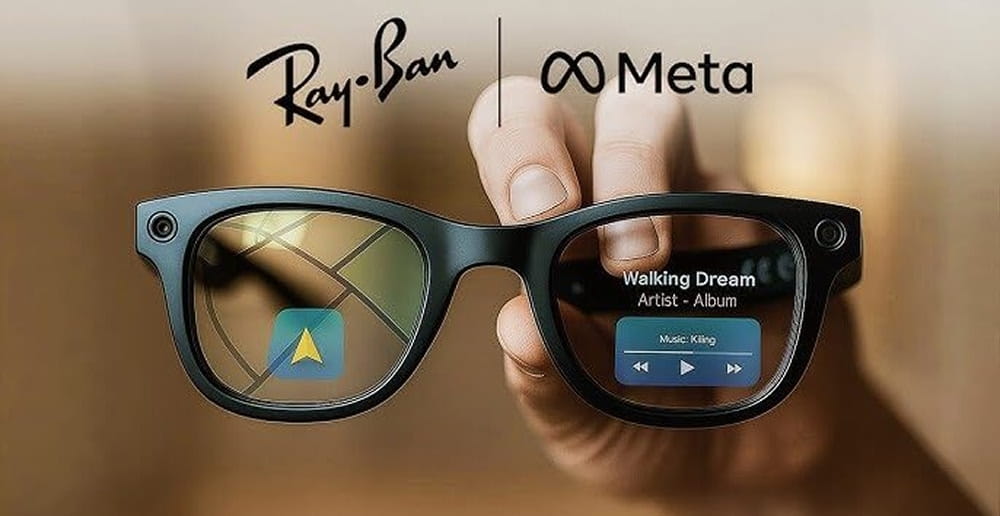
- Ray-Ban Meta – the most recognizable consumer-facing AI smart glasses right now. They mix familiar eyewear design with cameras, open-ear audio, and Meta AI.
- Google – back in the race through Gemini and Android XR. Google’s role in AI glasses is less about one dominant pair today and more about building the software foundation for future devices.
- Xiaomi – entered the market in mid-2025 with a focus on practical, utility-driven features aimed at the Asian and global markets
- Apple – while they pushed the bulky, ultra-premium Vision Pro, their true everyday AI glasses are highly awaited in late 2026-2027. Many believe that Apple's entry into the smart glasses market will catalyze extreme mainstream demand, repeating the historical pattern observed with the Apple Watch.
- Amazon – Echo Frames intentionally skip the camera and focus purely on audio with Alexa.
Meta, Google, Ray-Ban, Xiaomi & Others: How They Differ
Meta and Ray-Ban Meta are closest to the mass market. They care about style, easy everyday use, voice assistance, photos, short videos, and quick consumer adoption.
However, Meta wants your social life. Their AI smart glasses are built to capture content for Instagram, while their AI harvests conversational data to feed their insatiable ad engine.
Google’s strength in AI smart glasses is software, AI models, and platform reach. It wants the operating system layer, not just one pair of frames.
Xiaomi is flooding the market with affordable, feature-rich hardware to make AI smart glasses more accessible to the average consumer. Its version of AI glasses tends to feel more practical, more aggressive, and more value-driven.
Apple is keeping people waiting. If it is serious about entering the AI glasses market, it will likely focus on tight ecosystem control, polished hardware and a more premium experience.
Amazon is the simplest of the group. Its smart glasses are closer to voice-first wearable assistants than full AI smart glasses built around cameras and visual context.
The core difference is about who gets to monetize your real-time reality
Pros and Cons
Using AI glasses has its pros and cons. On the one hand, they can boost personal productivity and accessibility, but on the other, there are technological and social issues to consider.
Advantages
- hands-free help when your phone would slow you down
- faster access to information in motion
- easy capture of real, unplanned moments
- real-time translation in travel and everyday conversations
- contextual answers based on what you see or ask
- less screen friction during simple tasks
- useful accessibility support through audio guidance and live recognition
- more natural interaction than tapping through apps
The best thing about AI smart glasses is speed. Ask, hear, and move on without unlocking a screen.
Disadvantages and tech barriers
- serious privacy concerns around cameras, microphones, and cloud processing
- battery limits that show up fast in real-life use
- uneven AI accuracy, especially in noisy or messy environments
- social discomfort when other people do not know whether AI glasses are recording
- high prices for products that still feel early
- limited usefulness if the software ecosystem is weak
- dependence on internet access or a connected phone in many cases
- weak performance in low light, crowded places, or loud streets
- processing heavy AI algorithms drains batteries incredibly fast
- many AI smart glasses still feel bulky, fragile, or awkward for all-day wear
- many features feel impressive once, then depend on whether they become part of a real habit
That is the pattern with AI glasses right now. The upside is real, the friction is real too.
The Privacy Question: Are AI Glasses Safe to Wear?
The honest answer: AI glasses are not automatically unsafe, but they are not neutral either.
A normal pair of glasses does not collect data. AI smart glasses can collect voice, video, images, location context, behavioral patterns, and sometimes far more than the wearer realizes. That changes the privacy equation completely.
The biggest problem is not only what the wearer chooses to record, it is what the device, the app, the cloud pipeline, and the company behind it may capture, store, review, or learn from along the way.
Independent investigations recently exposed a thriving online black market where hobbyists charge a mere $60 to physically disable the LED indicator on Meta Ray-Bans.
Why AI glasses create a different kind of privacy risk
Unlike a smartphone, where you have to hold it up to record, AI glasses can capture media discreetly. Although devices like the Ray-Ban Meta include an LED indicator, this light is usually too small to be noticed in bright environments or can be easily obscured.
What experts are worried about
Privacy researchers keep returning to the same point: AI glasses do not only affect the buyer. They affect everyone around the buyer too.
Researchers studying camera glasses say there's a direct conflict between the wearer's convenience and the privacy of others. For example, one person wants useful features, another person does not want to be quietly recorded, analyzed, or identified.
At the end of 2025, there were a few high-profile incidents where users filmed strangers in public without permission, even in places like gyms and campuses, which led to calls for stricter rules.
The human review controversy
In early 2026, a big investigation revealed that Meta was using low-paid contractors in Kenya (through a subcontractor named Sama) to manually review and "label" video and audio data captured by the glasses. This data often included highly sensitive material:
- Intimate acts and nudity in private bedrooms.
- Visible financial information, such as credit card numbers and bank statements.
- Private medical conversations and bathroom visits.
A class-action lawsuit filed in the Northern District of California (Gina Bartone v. Meta) claiming that Meta didn't adequately disclose the scope of this human review, which is a violation of the California Consumer Privacy Act (CCPA) and other state privacy laws.
Biometric data and surveillance risks
AI glasses can capture voiceprints, facial recognition data, and eye-tracking patterns. Under laws like the Illinois Biometric Information Privacy Act (BIPA), companies have to obtain written consent before collecting such data. If they don't, they could be hit with huge fines of up to $5,000 per violation. What's more, in 2024, students at Harvard showed that Ray-Ban Meta glasses could be paired with facial recognition software to instantly identify strangers in public by matching their faces to social media profiles.
Your cloud connection
Cybersecurity experts agree on one fundamental truth: data in transit is data at risk.
Typically, when AI smart glasses capture your environment, they don't process everything locally on the frames. They'll send your biometric data, voiceprints and what you're seeing to an app on your phone, which will sync it straight away to a remote cloud server.
Privacy is not the only safety question
There is also a physical and operational side to AI glasses.
The eye-health panic is often overstated. The bigger short-term issue of smart glasses is strain: dry eyes, headaches, and visual fatigue when displays, focus distance, and long sessions do not play well together.
Driving is another grey zone. Audio guidance is one thing, but visual overlays, active menus, or AI interactions in your line of sight are another. In practice, AI smart glasses can become a distracted-driving device very quickly.
At work, the risk changes again. In an office, AI glasses can expose screens, meetings, contracts, and client data. In industrial spaces, they can help with hands-free instructions, but only if they meet safety rules and do not distract people around machinery.
Social etiquette and safe usage guidelines
With cameras and microphones becoming a regular part of our lives, we'll need to figure out how to use them in a way that's respectful and considerate, just like how we all learned to use our phones in public.
To use AI glasses safely and ethically, users must become highly informed consumers. This means reading privacy policies and adjusting settings to maximum security, specifically opting out of data-sharing agreements that allow cloud providers to use personal audio/visual data for AI model training.
In public spaces, users must be hyper-aware of their surroundings.
So, are AI glasses safe?
Technically, AI glasses can be used safely. Socially and privately, the answer depends on how they are designed, what settings are enabled, where they are used, and how disciplined the wearer is.
That is why the real question is not “Are AI smart glasses safe?” but “Safe for whom?”
Safe for the wearer’s account? Safe for the people nearby? Safe from cloud overreach? Safe from misuse? Safe from turning ordinary human moments into training data?
Right now, AI glasses are safer when they do less, store less, process more on-device, and make recording obvious. They become riskier when they depend heavily on cloud AI, vague consent, hidden capture, long retention, and a business model built around data.
How to Use AI Glasses Safely
Long-term use of near-eye displays and constant AI interaction means we need to think about physical, personal, and social safety.
Personal privacy
- Read the privacy settings before you use the device. Do not trust the default setup. Check what your AI smart glasses store, sync, upload, and keep by default.
- Turn off features you do not need. If you will not use voice wake, cloud media, location access, or AI camera features every day, disable them. Fewer active features means fewer ways for data to leak.
- Delete voice history and cloud media regularly. Many AI glasses keep more than people expect. Make manual deletion part of your routine.
- Use strong account security. Protect the account behind your AI smart glasses with a strong password and two-factor authentication. If the account is weak, the device is weak.
- Keep software updated. Updates are not just feature drops. They patch security holes, bugs, and data-handling problems.
- Avoid sharing private documents through AI features. Bank cards, passports, medical forms, contracts, and internal business files should stay away from camera-based AI prompts.
- Review the companion app permissions. The glasses are only part of the system. The app may have access to photos, contacts, Bluetooth, microphone, location, and cloud sync.
- Separate personal and work use. If you use AI glasses for business, keep work accounts, internal data, and confidential conversations away from casual consumer settings.
Health
- The 20-20-20 rule: every 20 minutes, focus on an object at least 20 feet away for at least 20 seconds to allow the ciliary muscles to relax.
- Do not wear them for every task just because you can. AI smart glasses are useful in motion, but constant use can turn convenience into mental clutter.
- Blink rate management: studies show that blink rates drop from 15-20 per minute to as low as 5-7 per minute when using digital screens. Blink consciously!
- Treat driving as a high-risk use case. Audio prompts may feel harmless, but visual overlays, active AI responses, and menu interactions can distract you quickly.
- Use extra caution with children. Kids are more vulnerable to overuse, distraction, and casual recording they do not fully understand.
Social etiquette and legal boundaries
- Ask before recording people. This sounds basic, but it is where trust starts.
- Tell people when the glasses are recording or translating. People should not have to guess whether a device on your face is active.
- Do not use AI glasses in sensitive spaces. Bathrooms, clinics, schools, private offices, locker rooms, religious spaces, and confidential meetings are the wrong places for them.
- Respect no-glass zones. Some businesses, gyms, workplaces, and government buildings already treat AI glasses as a privacy risk. If a space bans them, do not argue with the rule.
- Do not normalize constant capture. Just because AI glasses can record quickly does not mean they should become always-ready memory machines.
- Check local recording laws. Audio and video consent rules vary by country and region. Do not assume your AI smart glasses are legally safe just because the feature exists.
- Be extra careful in workplaces. Offices, client meetings, and industrial sites all bring legal and ethical risks around confidentiality, safety, trade secrets, and employee trust.
The best rule is simple: use AI smart glasses like a powerful tool, not like invisible background tech. The more they know about you, the higher the privacy risk.
FAQ about AI glasses
What are AI glasses?
AI glasses are wearable glasses with built-in cameras, microphones, speakers, sensors, and AI software that can respond to voice commands, analyze what is in front of you, and deliver help.
What do AI glasses do?
AI glasses typically can take photos, record short videos, answer spoken questions, translate speech or text, read signs and messages aloud, help with navigation, identify objects or places, and give contextual answers based on what you see.
Are AI glasses always recording?
Usually no. Most AI glasses are not recording every second by default. But that does not mean they are private by default. Voice activation, quick capture, cloud processing, and stored interactions can still create real privacy risks.
Are AI smart glasses safe for privacy?
They can be used carefully, but AI smart glasses are not privacy-first devices by nature. Safety depends on the brand, settings, storage model, and how responsibly the wearer uses them.
Can AI glasses identify people?
Some current AI glasses can identify objects, landmarks, or text. Facial recognition is the more controversial next step, and that is where privacy concerns become much more serious.
Are AI glasses safe in public?
They are legal in many places, but public use is not the same as socially accepted use. AI smart glasses can make people uncomfortable because they blur the line between normal eyewear and hidden recording tech.
What is the biggest privacy risk with AI glasses?
The biggest risk is quiet overcollection: recording, analyzing, or storing more than users and bystanders realize.
Are AI glasses bad for your eyes?
Not in the simple myth-based way people often claim. The more realistic issue is eye strain, fatigue, dryness, or headaches during long sessions, especially with display-heavy use.